


 Oct 1, 2026
Every October is dedicated to raising awareness about Attention-Deficit/Hyperactivity Disorder (ADHD). This year’s theme, “The Many Faces of ADHD,” highlights the diverse experiences, challenges, and different ways ADHD can appear from one person to another.
Because ADHD doesn’t fit a single mold: the child who can’t sit still in class, the adult woman who delivers brilliant work at the last possible minute, the engineer whose mind wanders during an important meeting, the student who reads the same paragraph five times without absorbing it. They are all faces of ADHD.
But they share one thing when they open a web browser: a digital world that was never designed with their kind of mind in mind.
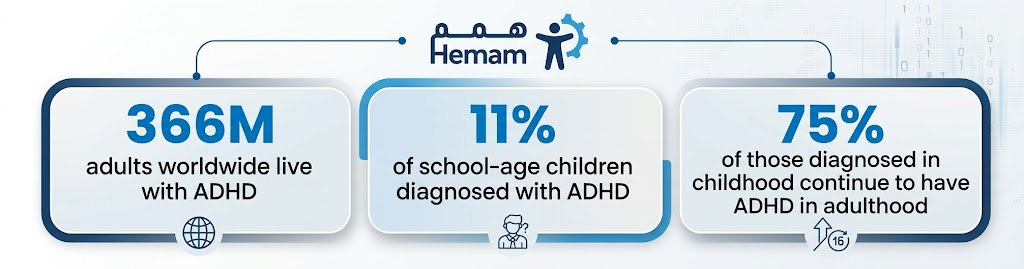
Sources: CHADD 2025 · CDC, 2024
I. What Is ADHD, Really?
ADHD is a neurodevelopmental disorder that affects how the brain processes information and regulates attention. It is not laziness, not a lack of willpower, it is a genuine difference in brain chemistry and function.
ADHD comes in three main presentations:
- Predominantly inattentive – difficulty completing tasks, staying organized, and remembering, without obvious hyperactivity.
- Predominantly hyperactive-impulsive – excessive movement, difficulty waiting, actions before thinking.
- Combined presentation – the most common, bringing both together.
II. The Many Faces – Real People, Different Experiences
This year’s theme reminds us that ADHD doesn’t look one way. Here are three faces from our community:
| 👧 Laila, 9 – The Smart Student Who “Doesn’t Pay Attention” |
| Layla can memorize a full poem after hearing it once and solve puzzles faster than her classmates, but she can’t finish a math exercise without getting distracted three times. Her teacher says “if she just focused she’d be top of the class.” Her mother knows the issue runs deeper than willingness. |
| 👨 Khaled, 31 – The Manager Who Procrastinates |
| Khaled thrives in a crisis; pressure ignites his focus. But he puts off routine tasks for days, opens five tabs at once, and closes half of them without completing any. He wasn’t diagnosed with ADHD until he was thirty. Before that, he only blamed himself. |
| 👩 Sara, 24 – The Student Who Re-reads Everything |
| Sara reads the same paragraph repeatedly and finds the words float across the surface without sinking in. She opened the university website to register for a course, but the page was packed with links, buttons, ads, and pop-ups. She closed the browser after two minutes. |
III. The Internet – a World Designed for ADHD to Fail
Think about how most websites look: moving buttons, flashing ads, popping notifications, content competing for attention from every direction. For someone without ADHD, this is annoying noise.
For someone with ADHD, it’s what’s called “overload” – an excess of stimulation that interrupts attention before it even forms. The result isn’t just inconvenience; it’s an unfinished task, an abandoned website, and a feeling of frustration, or guilt.
| What Makes the Web Hard for People with ADHD? |
| Moving content and flashing ads – steal attention before it settles on the original task. |
| Long pages packed with dense text create a “wall of text” that makes it difficult to focus and absorb the content. |
| Too many choices and links at once – multiple decisions exhaust the mind and block completion. |
| No clear visual hierarchy – without headings or whitespace, the user gets lost in the content. |
| Long forms and multi-step processes – every extra step is a potential point of distraction and dropout. |
| Unexpected pop-ups – interrupt mental flow and make it hard to return to the original path. |
IV. What Hemam Tools Offer This Segment
Hemam Tools are built on the principle that every user deserves a digital experience that matches how their mind works, not just how the majority’s does. People with ADHD find in Hemam Tools something that restores balance to their experience:
| Hemam Tools and ADHD – What Changes in Practice? |
| Focus Mode – hides ads, sidebars, and distracting elements, leaving only the core content. A chaotic page becomes a calm one. |
| Stop Animations – pauses all moving content in one tap, removing the biggest source of attention theft. |
| Font and Spacing Adjustments – a reading-friendly font with wider line spacing reduces visual fatigue and helps follow text without losing the place. |
| Dark Mode – reduces screen brightness and blue light, creating a calmer visual environment for both eye and mind. |
| Contrast Settings – multiple contrast options help those who find bright backgrounds disorienting or tiring. |
| Full User Control – all tools activated by the user whenever needed, with a single tap, no device settings required. |
V. A Message for Website Designers
366 million adults live with ADHD – a number larger than the combined population of all Gulf countries. This is not a marginal segment; it is an organic part of any digital audience.
A website that reduces visual clutter, gives users control over their experience, and is designed with a clear visual hierarchy doesn’t only serve people with ADHD. It serves every exhausted, busy user; every parent browsing with a child on one arm and a phone in the other.
The Bottom Line: October Starts with Awareness, and Must Continue with Action
ADHD awareness doesn’t stop at understanding a diagnosis; it extends to every decision we make in designing spaces, whether physical or digital. A website that thinks about the ADHD user isn’t just completing a human act; it’s engaging a segment that is creative, intelligent, and deeply loyal when it finds a space that respects the way its mind works.
ADHD isn’t a shortage of attention.. it’s a difference in how it’s distributed.
A thoughtfully designed website is one that keeps everyone – including people with ADHD – present and able to complete what they came to do. Find out how at hemam.io